Midterm Review of the New Urban Agenda (NUA) - Multi-stakeholder Panel 3 and Panel 4 and Closing Segment, General Assembly, 80th session.
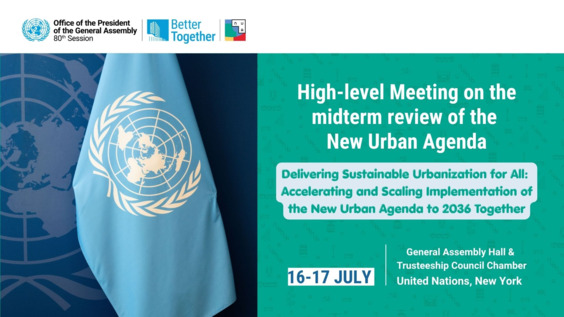
The theme of the High-Level Meeting of the General Assembly on the Midterm Review of the New Urban Agenda (NUA), 16-17 July 2026, is "Delivering Sustainable Urbanization for All: Accelerating and Scaling Implementation of the New Urban Agenda to 2036 Together".
- Multi-stakeholder Panel 3 - Delivering Urban Resilience in an Era of Escalating Crises on Climate, Disaster and Environmental Risk.
As climate change, environmental degradation, and disaster risks intensify, cities are increasingly on the frontlines of global crises. Despite growing global commitments including under the Rio Conventions, the Sendai Framework for Disaster Risk Reduction, and other agreements, significant gaps remain in translating these frameworks into integrated, coherent, localized impacts. While many countries have embedded urban dimensions into their NDCs, housing dimensions and adaptation remain underfinanced, and resilience-building efforts are often fragmented across sectors and scales.
This panel will examine how to improve climate and disaster resilience in cities through integrated, inclusive, people-centered, and place-based actions to protect lives and livelihoods, strengthen environmental sustainability and safeguard long-term development.
Multi-stakeholder Panel 4 - Activating Future-Ready Cities through Governance, Capacity, Data, Innovation and Digital Transformation
As cities navigate an increasingly complex and evolving global context, strengthening local and subnational authorities, multilevel governance, institutional capacity, and forward-looking approaches are central to delivering the NUA. Future ready cities are built on data that is trusted, interoperable, and actionable, enabling governments to integrate policy, capacity, and digital tools into coherent systems that drive resilience, equity, and long-term sustainability. At the same time, rapid digital transformation and emerging technologies — including artificial intelligence — are reshaping how cities are planned, designed, managed, and governed, leveraging new and existing opportunities while mitigating risks related to inequality, access, and rights. This calls for more integrated, inclusive, and forward-looking systems the Pconsideringact of the Future and its annexes.
This panel will examine how to strengthen sub-national entities and multilevel governance, enhance capacity, leverage digital innovation responsibly, and apply strategic foresight to support and implement resilient, inclusive and future-ready cities.
Related Sites and Documents: Concept note.
Watch the Midterm Review of the New Urban Agenda (NUA) - Multi-stakeholder Panel 3 and Panel 4 and Closing Segment, General Assembly, 80th session!
General Assembly
As cities navigate an increasingly complex and evolving global context, strengthening local and subnational authorities, multilevel governance, institutional capacity, and forward-looking approaches are central to delivering the NUA. Future ready cities are built on data that is trusted, interoperable, and actionable, enabling governments to integrate policy, capacity, and digital tools into coherent systems that drive resilience, equity, and long-term sustainability. At the same time, rapid digital transformation and emerging technologies — including artificial intelligence — are reshaping how cities are planned, designed, managed, and governed, leveraging new and existing opportunities while mitigating risks related to inequality, access, and rights. This calls for more integrated, inclusive, and forward-looking systems the Pconsideringact of the Future and its annexes.
This panel will examine how to strengthen sub-national entities and multilevel governance, enhance capacity, leverage digital innovation responsibly, and apply strategic foresight to support and implement resilient, inclusive and future-ready cities.
Related Sites and Documents: Concept note.
General Assembly


Comments
Post a Comment