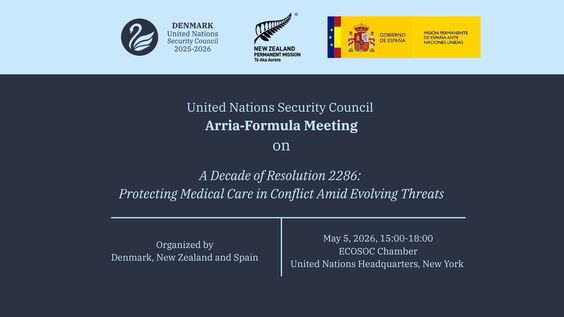
A Decade of Resolution 2286: Protecting Medical Care in Conflict Amid Evolving Threats.
The United Natios Security Council Arria‑Formula Meeting organized by Denmark, New Zealand and Spain. To provide an informal space for the Security Council and the wider UN membership to reflect on the implementation of the resolution, key developments, and emergent threats and opportunities to the protection of medical mission in armed conflict since 2016.
Guiding Questions
How can the Security Council and the broader UN membership better reflect and respond to the growing dangers facing medical care within the Protection of Civilians agenda, and what new tools, mechanisms, or commitments should be considered at this major milestone?
What measures can be taken to strengthen the implementation of international humanitarian law and to ensure that it is interpreted and applied consistently by all parties in this area?
How do we safeguard the risks posed by new and emerging technologies, and how can we utilise the opportunities that these technologies represent in ensuring compliance with international humanitarian law?
What new measures or mechanisms can enhance accountability for attacks on healthcare and for undue interference with medical services exclusively engaged in medical duties, and how can the UN Security Council and the broader UN membership better address violations of international humanitarian law?
Opening remarks
What measures can be taken to strengthen the implementation of international humanitarian law and to ensure that it is interpreted and applied consistently by all parties in this area?
How do we safeguard the risks posed by new and emerging technologies, and how can we utilise the opportunities that these technologies represent in ensuring compliance with international humanitarian law?
What new measures or mechanisms can enhance accountability for attacks on healthcare and for undue interference with medical services exclusively engaged in medical duties, and how can the UN Security Council and the broader UN membership better address violations of international humanitarian law?
Opening remarks
H.E. Ambassador Christina Markus Lassen, Permanent Representative of Denmark.
H.E. Ambassador Hector Gomez Hernandez, Permanent Representative of Spain.
H.E. Ambassador Carolyn Schwalger, Permanent Representative of New Zealand.
Briefers
H.E. Ambassador Hector Gomez Hernandez, Permanent Representative of Spain.
H.E. Ambassador Carolyn Schwalger, Permanent Representative of New Zealand.
Briefers
Ms. Claude Maon, Intersectional Legal Director of Médecins Sans Frontières / Doctors Without Borders (MSF).
Professor Len Rubenstein, Johns Hopkins Bloomberg School of Public Health, Safeguarding Health in Confl ict Coalition (SHCC).
Professor Naz. K. Modirzadeh, Harvard Law School, Director of the Harvard Law School Programme on International Law and Armed Conflict (PILAC).
Ms. Elyse Mosquini, Permanent Observer of the International Red Cross and Red Crescent (ICRC) to the United Nations.
[Extract from the organizer's concept note]
Related Sites and Documents: Concept note.
Watch a Decade of Resolution 2286: Protecting Medical Care in Conflict Amid Evolving Threats - UN Security Council Arria-Formula Meeting!
Security Council
Professor Len Rubenstein, Johns Hopkins Bloomberg School of Public Health, Safeguarding Health in Confl ict Coalition (SHCC).
Professor Naz. K. Modirzadeh, Harvard Law School, Director of the Harvard Law School Programme on International Law and Armed Conflict (PILAC).
Ms. Elyse Mosquini, Permanent Observer of the International Red Cross and Red Crescent (ICRC) to the United Nations.
[Extract from the organizer's concept note]
Related Sites and Documents: Concept note.
Security Council


Comments
Post a Comment